
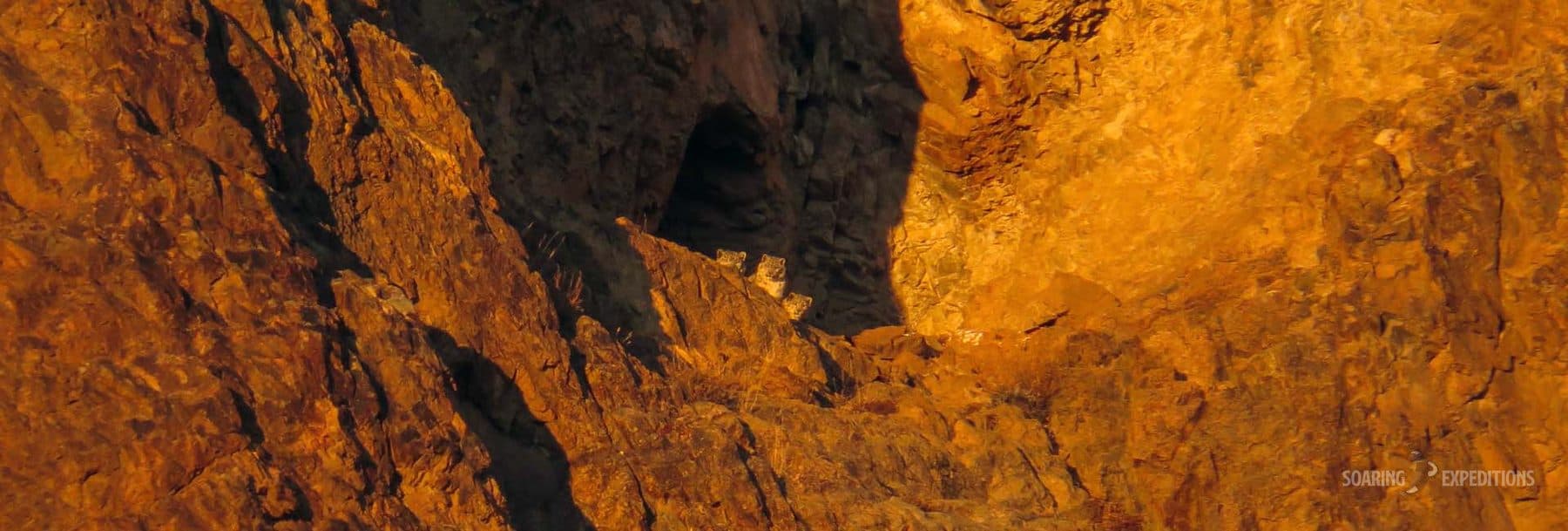
A living corridor
The Valley of Wild Cats
From the glaciers of the Altai to the larch forests of Khuvsgul — one connected landscape where Mongolia’s wild cats can move, hunt and breed as they always have.
Snow leopards do not recognise province borders. A young male dispersing from the Kharkhiraa massif may travel hundreds of kilometres in search of territory — and for decades, each mountain range he crossed was an island, separated by valleys where he risked conflict with herders and their livestock.
The Wild Cats Valley, established by the MUR Initiative, changes that. Four conservation centers — Kharkhiraa, Margaz, Bulnai and Aldarkhaan — anchor a corridor of more than 11 million hectares across Hovd, Uvs, Zavkhan and Khuvsgul provinces, protecting over 180 species. Camera-trap lines maintained through the Mongolian winter now document cats moving between the massifs: the corridor is connecting populations across western Mongolia.
The model works because herder families are partners, not bystanders. They maintain camera lines, monitor migrations, host research and expedition teams, and earn direct income from every guest — so a living snow leopard is worth more to a valley than a lost sheep ever cost it.
Soaring Expeditions is proud to be the travel partner of this work. A share of every expedition funds the corridor, and our flagship journey — Mongolia’s Valley of Wild Cats — traverses it end to end over 16 days: the only expedition of its kind in Mongolia.
The four centers
Altai Mountains
Hovd & Uvs provinces
High snow-leopard country where the Kharkhiraa and Turgen massifs rise over 4,000 m — the western anchor of the Wild Cats Valley corridor.
Margaz Mountains
Zavkhan province
A mountain-to-water transition zone where snow leopards and Pallas's cats share the same slopes — the corridor's scientific heart.
Bulnai Mountains
Khuvsgul province
Forested northern ranges where lynx, grey wolf and wolverine roam the taiga edge — the corridor's wildest, least-visited reach.
Khomyn Tal National Park
Zavkhan province
Steppe and dune country famous for its reintroduced takhi (Przewalski's horses) — and for grey wolves hunting across open ground.